



Federal investigators said Monday they are committed to investigating a deadly plane crash that occurred at Miami International Airport Sunday afternoon.
Investigators are examining whether an Amazon cargo jet touched down too far down the runway to stop safely before crashing off a runway at the airport, killing five people and raising broader questions about runway safety, pilot decision-making and weather conditions during landing.
The National Transportation Safety Board and Federal Aviation Administration are investigating Sunday’s crash involving a Boeing 767 operated for Amazon Prime Air by North Carolina-based cargo carrier 21 Air.
“We are deeply, deeply committed to our duty, our responsibilities as an investigative agency, to determine how this accident occurred, why it happened, with one goal in mind – safety. And that's to prevent it from happening again,” NTSB Board Chief Jennifer Homendy said during a press conference Monday.
Video circulating online appears to show the aircraft remaining airborne longer than normal before touching down and overrunning the runway. The plane crossed a roadway near airport warehouses and slammed into multiple vehicles before catching fire.
At least five people were killed and several others injured. Homendy said the victims involved passengers in a van inside the airport and a small SUV outside the airport that were struck by the plane as to barreled past the runway.
Homendy said investigators will probe every aspect of the crash, from tire marks and flight crew experience training to policies and procedures for 21 Air and their “contractual relationship with Amazon,” as well as air traffic control.
“We'll have a group of investigators focused on operations and human performance. They will look at the history of the accident flight,” Homendy said. “We will not be determining probable cause while we are on scene. We are here to document the scene and to collect the perishable evidence.”
Experts told Scripps News investigators will also review what happened in the final moments before landing, including the aircraft speed, weather conditions, braking systems, and whether pilots should have aborted the landing and attempted a go-around.
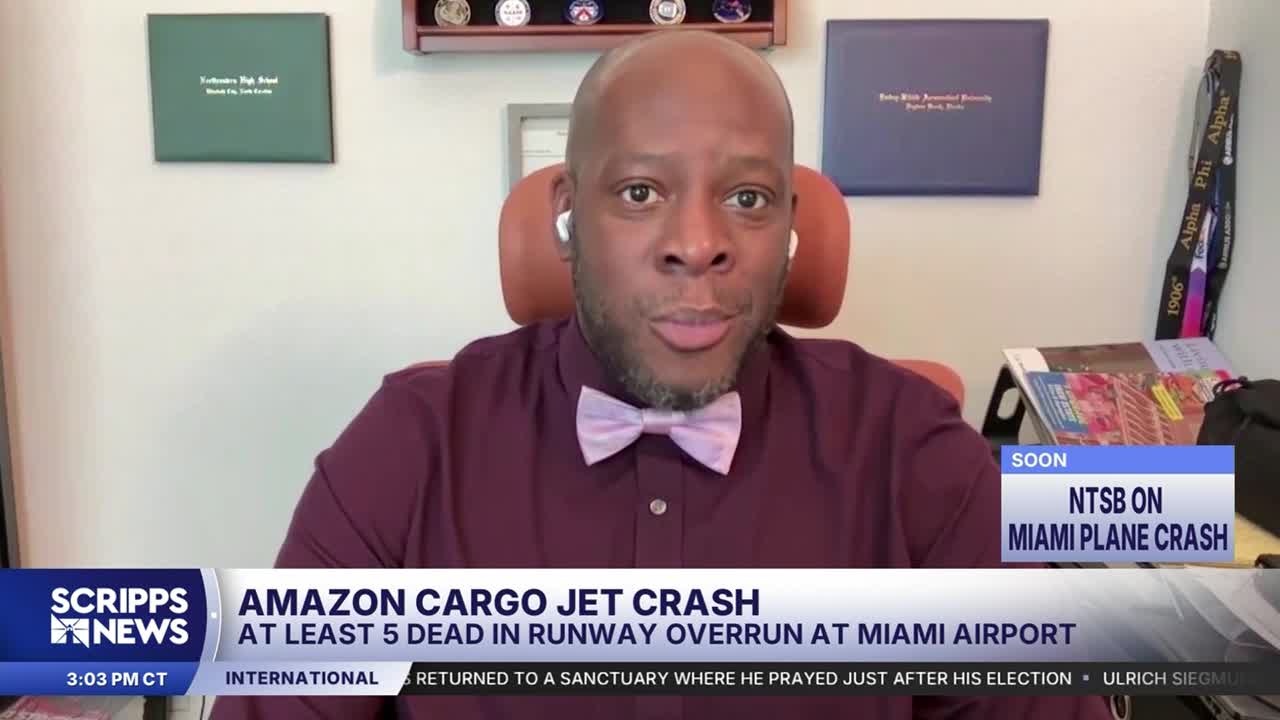
“If you’re unstabilized at a certain point, it’s company policy that you conduct what we call a go-around,” Aviation safety expert Anthony Brickhouse told Scripps News. “Why this aircraft did not go around yesterday, these are questions that have to be answered.”
Investigators will likely examine whether the crash stemmed from human, environmental or mechanical factors — or some combination of the three, Brickhouse said.
One of the central questions investigators are expected to examine is whether the aircraft had enough runway remaining to stop safely after touchdown.
Brickhouse said investigators will also review weather conditions and possible tailwinds, which can increase landing speed and reduce stopping distance.
Investigators will also examine the aircraft itself, including maintenance records and braking systems. The plane involved was a 32-year-old Boeing 767, a passenger aircraft that was converted into a cargo jet in 2015.
RELATED STORY | Airplane pilot killed in collision with Pennsylvania police helicopter near runway
Another issue drawing attention is runway safety infrastructure. Miami International Airport does not have an Engineered Materials Arresting System, or EMAS, installed on the runway involved in the crash. The system uses crushable material designed to slow and stop an aircraft that overruns a runway.
“It's a safety system that was designed to try to keep airports as safe as possible,” Brickhouse said. “It would be perfect if airports were located in the middle of nowhere, but that's not the case. Most of our big airports are right in the middle of populated areas.”
In a Statement to scripps news, a spokesperson for the Miami-Dade Aviation Department said the airport meets FAA runway safety requirements and undergoes annual federal safety inspections.
“The full 1,000-foot Runway Safety Area mandated by the FAA,” the spokesperson said, adding that EMAS “are generally used at airports where space constraints prevent a full runway safety area from being provided.”
The spokesperson said the airport will cooperate fully with the ongoing NTSB and FAA investigation and review any resulting recommendations.
Investigators are expected to rely heavily on the aircraft’s cockpit voice recorder and flight data recorder, which Homendy said were recovered, to reconstruct the final moments before the crash.
"Our whole goal as a safety agency is one thing. It's safety. It's to save lives. And that means our recommendations must be implemented, or we're going to be here again,” Homendy said.
