

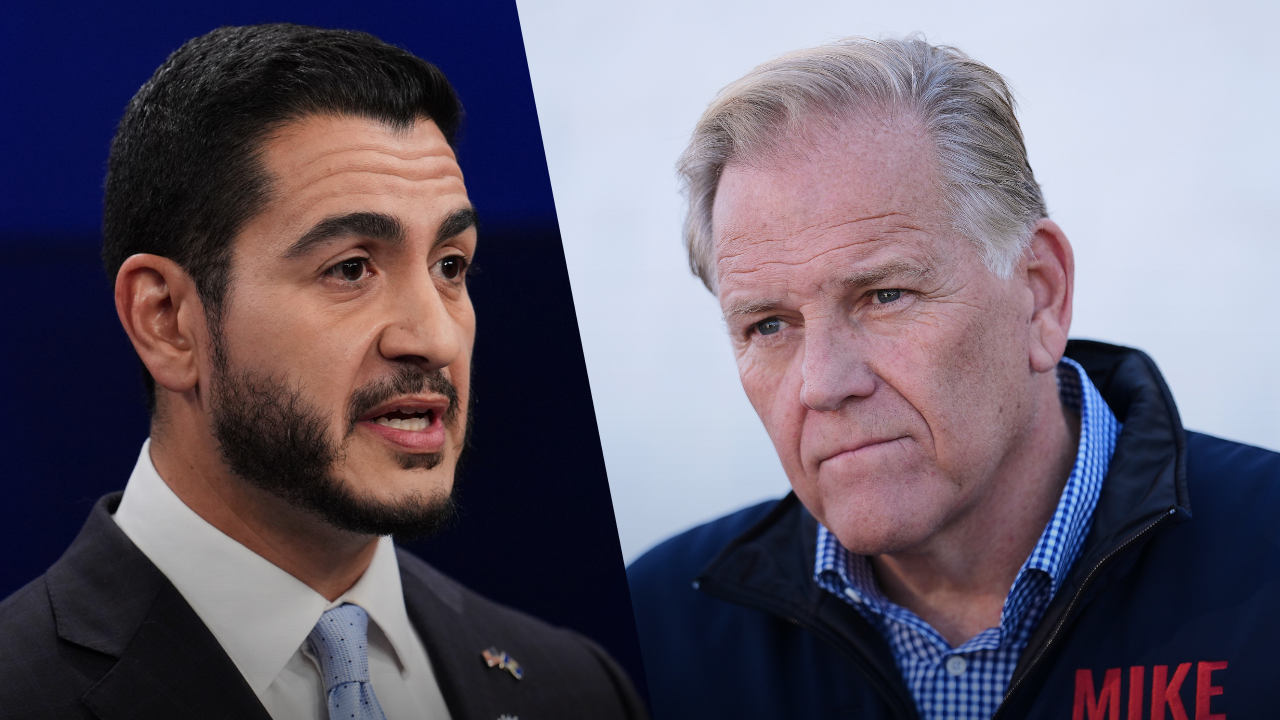


Less than two weeks before what could be a pivotal U.S. Senate race, Republican Mike Rogers and Democrat Abdul El-Sayed held a televised Wednesday, with polling showing a deadlocked contest.
The cost of living
El-Sayed said would back a full senate resolution to end the war in Iran, which he said is driving increases in costs of living.
"We need a war powers resolution rather than a Senator who's going to stand hip to hip with Donald Trump on this war that made no sense when it started, and certainly makes no sense now."
Rogers said more U.S. energy development would help lower costs for Michiganders.
On tariffs
"I have stepped back and said 'maybe these Canadian tariffs were not well thought through,' mainly because of the interaction between our automobile companies and Canada when it comes to just-in-time manufacturing," Rogers said. "You might want to send the guy back who can actually get the meeting to get these things worked out. If it's good for Michican I'm going to be for it, if it's bad for Michigan I'm going to be against it."
"I think we need to use tariffs specifically around how we can protect certain automotive opportunities, opportunities for growth and jobs that we actually need, rather than this haphazard approach," El-Sayed said.
Iran and national security
"The consequences of this war are that you're paying nearly $5 in gas. You're paying more in groceries because of the price of diesel. He has cheerlead this war all along because he stands hip to hip with Donald Trump." El-Sayed said.
Rogers warned that Iran would continue to work toward nuclear capability.
"You want to pay $8 a gallon for gas? Let Iran get a nuclear weapon. You lose control of that whole region," he said.
The costs of healthcare
Candidates were asked whether they supported expansion, modification or rollbacks of Affordable Care Act healthcare policies.
El-Sayed, who has campaigned on the deployment of Medicare for All, said he "certainly" supported expansion of the program.
He said Rogers' record on prescription drug prices would not be affordable.
"We cannot afford to have a United States Senator who is in bed with big pharma," El-Sayed said.
Rogers said a Medicare for All program would require $7 trillion a year in new taxes on families.
"It needs reform," Rogers said.
Strengthening Social Security
"It's got to be bipartisan," Rogers said of any policies that touch the program.
He said he would support a plan that would target $500 billion in fraud said to be associated with the program.
"I think we need to scrap the cap," El-Sayed said, referring to a ceiling on income above which Social Security taxes are no longer assessed.
He warned Republicans would seek to use investigations into fraud to privatize the Social Security program.
Federal voter ID laws
Moderators asked the candidates if they would support or oppose legislation that may impose federal voter identification requirements.
"This is about voter suppression," El-Sayed said. He did not directly answer the question. "We deserve the right to vote. Nobody should take that away from you."
"I think it's very reasonable and rational to ask for a voter ID," Rogers said.
Are you in favor of expanding the U.S Supreme Court?
Moderators asked the yes-or-no question to both candidates.
Rogers: No.
El-Sayed: Yes, but fairly.
WATCH | Talking to voters ahead of Michigan's closely-watched Senate midterm showdown
El-Sayed is vying to become the first Muslim American elected to the U.S. Senate. Rogers is hoping to become the first Republican to represent Michigan in the Senate since Spencer Abraham, who lost his reelection bid in 2000. Democrats have won nine consecutive U.S. Senate races in Michigan.
Although Democrats have maintained control of both of Michigan’s U.S. Senate seats, the state is considered a key battleground. President Donald Trump has won Michigan twice, demonstrating Republicans can compete statewide.
The debate was moderated by Scripps News Group Detroit Editorial Director Chuck Stokes, along with Detroit-based anchors Carolyn Clifford and Alicia Smith.
A Marist poll released Wednesday showed El-Sayed leading Rogers 50% to 48%, a difference within the poll’s margin of error. The poll also found both candidates had high unfavorable ratings. Forty-eight percent of likely voters viewed El-Sayed unfavorably, while 52% had an unfavorable view of Rogers.
RELATED STORY | Abdul El-Sayed emphasizes Muslim faith after Trump calls him a ‘jihadist’
The poll also indicated many Michigan families are struggling more financially than they were a year ago. Forty-three percent of likely voters said they were worse off financially, compared with 16% who said they were better off.
El-Sayed’s faith has come under attack during his campaign to become the country’s first Muslim U.S. senator. Republicans have sought to portray the Democratic nominee as sympathetic to interests connected to Islamic terrorism.
Last week, Trump referred to El-Sayed as “Mohammed” and falsely called the former public health official a “jihadist.”
Over the weekend, El-Sayed denounced the Muslim Brotherhood, an Islamic political movement founded in Egypt in 1928.
RELATED STORY | Democrats fear slippage with Black voters makes Michigan Senate race feel ‘far closer than it should’
Meanwhile, El-Sayed has sought to tie Rogers to many of Trump’s policies, including tariffs and the war in Iran. Rogers, a former member of the U.S. House, has at times sought to distance himself from some of Trump’s more divisive policies.