
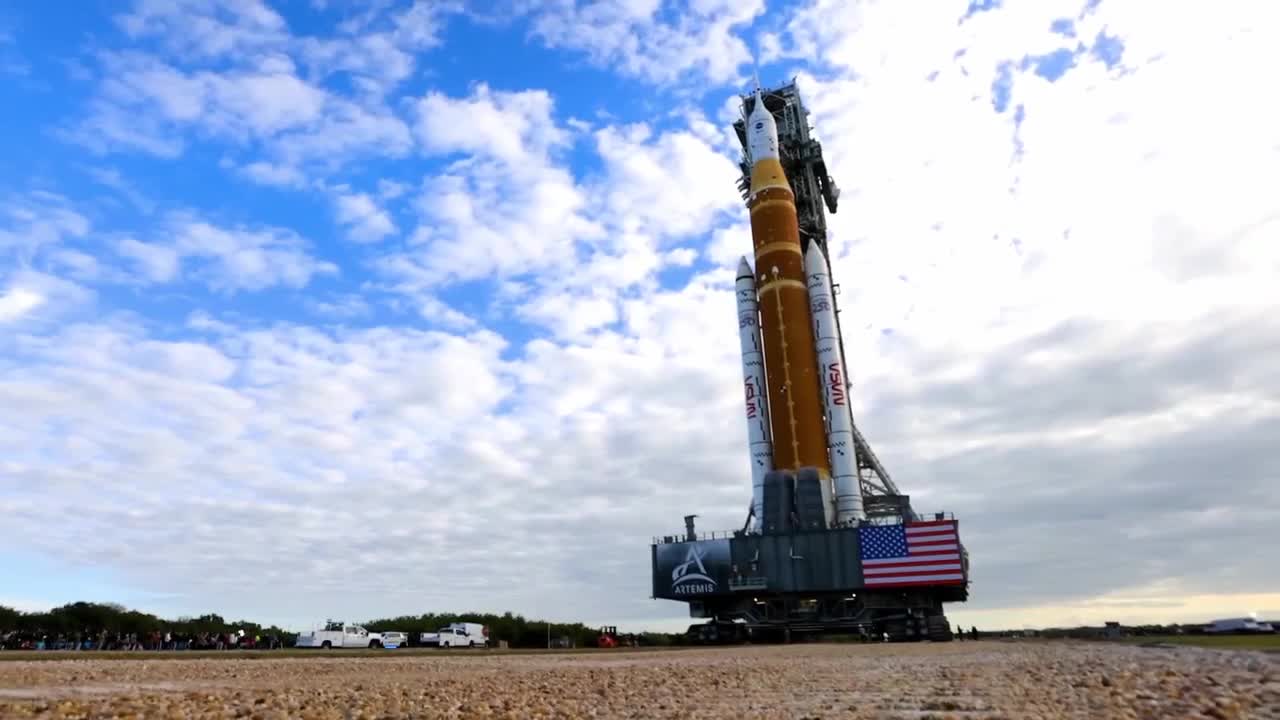


PROMONTORY, Utah — Four astronauts are heading back to the moon for the first time in five decades as part of the Artemis II mission, and their journey relies heavily on the work of thousands of people in Utah.
Without Utah's contributions, getting back to space would not be possible. Here are five ways the state is powering the countdown to Artemis II.
#5 The SLS boosters:
The solid rocket boosters are the long white cylinders mounted on the side of the Space Launch System core stage, and they provide 75% of the rocket's thrust. They were manufactured at Northrop Grumman's Promontory facility in northern Utah.
Mark Tobias, a Northrop Grumman technical fellow, highlighted the facility's importance to the space program.
"What we have here in northern Utah is really a national asset. So it's really a unique facility that has a really rich history of providing high quality, high reliability space hardware," Tobias said.
The entire booster is approximately 177 feet long. Together, the boosters weigh 1.6 million pounds and provide over 7.2 million pounds of thrust. They are derived from the Space Shuttle solid rocket boosters, which were also built in Utah for all 135 launches.
The Artemis II boosters include an added fifth segment for a longer burn time needed to reach the moon. Many physical parts of the current boosters flew on multiple Space Shuttle missions.
"Every piece of hardware, almost without exception, has some sort of flight experience from the Space Shuttle Program. We take that hardware, we inspect it, then we rebuild it and turn it into the boosters that are used on the SLS," Tobias said.
The tops of the twin boosters display "America 250" emblems, marking the nation's 250th anniversary of independence, which were painted by Utahns.
#4 The Launch Abort Motors
The launch abort motors sit at the very top of the rocket above the Orion spacecraft where the astronauts are located.
The system is designed to deliver around 400,000 pounds of thrust for about five seconds, which is enough to pull the astronauts away from an emergency and land safely. This system was also built and tested at Northrop Grumman's facilities in Utah.
#3 The Program Manager Dave Reynolds
Utah's contribution extends beyond hardware to the people leading the mission, including Dave Reynolds, the SLS booster program manager for NASA. Reynolds grew up in Layton, Utah, and works at the Marshall Space Flight Center.
"Yeah, safety in our program is absolutely paramount. This is the first time that we have flown humans to the moon since 1972," Reynolds said.
Reynolds said he was always interested in space flight, but the Challenger explosion when he was an 8-year-old piqued his interest and solidified his desire to join NASA.
"Something in me changed that day, and I thought, this is what I want to do with my little 8-year-old self. This is what I wanted. I want to be involved in this somehow," Reynolds said.
Today, he is a key part of the team leading up to the countdown to launch.
"And ultimately, when the day comes, we'll push the button and we'll let this thing go," Reynolds said.
#2 Former Sen. Orrin Hatch
In 2010, after Utah finished building solid rocket boosters for the shuttle missions, the NASA Authorization Act was being crafted.
Former Sen. Orrin Hatch, a Republican from Utah, wrote language into the bill detailing specific payload requirements for a heavy-lift space launch system.
This language ultimately shaped the SLS and guaranteed Utah would stay involved in its future. Hatch called it taking Utah's solid rocket industry "off life support" following the end of the shuttle missions, and his efforts are why Utah manufactures those boosters today.
"I know their industry is and how important this is to the future of our country, the future of our national security programs and our national security," Hatch said.
#1 The B.O.L.E. motor
Looking toward the future of the Artemis missions to the moon and eventually Mars, Utah is developing the Booster Obsolescence and Life Extension motor. It is the most powerful segmented solid rocket motor ever built.
The BOLE motor is being designed to increase thrust and completely redesign the structure of the boosters. The first of four tests for the motor took place last summer. The BOLE booster is expected to take over around the Artemis 8 mission, with the potential to take the SLS and a newly designed spacecraft to the moon.
So that's 5 ways that Utah is powering the Artemis missions and man kind back to the moon starting with Artemis II.
So, remember as you see images of those 4 brave astronauts soaring around the moon, you now know the people and the state that powered their way to get there.
This story was reported on-air by a journalist and has been converted to this platform with the assistance of AI. Our editorial team verifies all reporting on all platforms for fairness and accuracy.
