

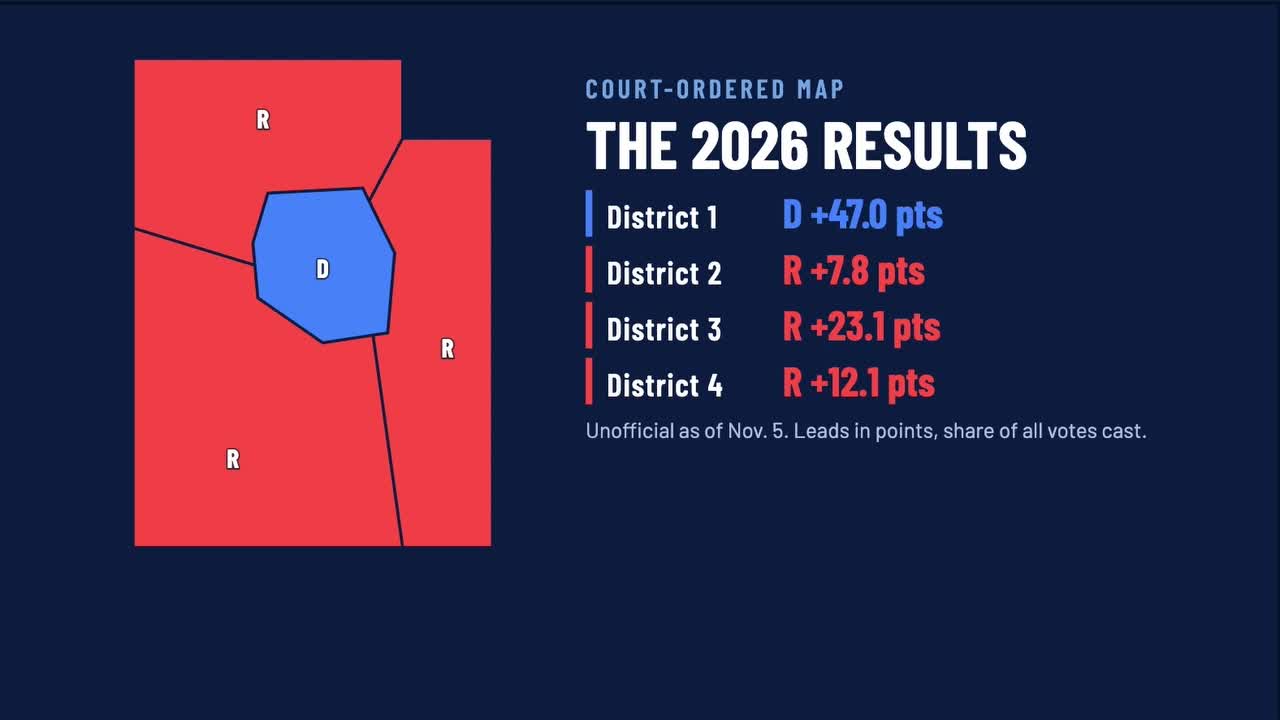


SALT LAKE CITY — After the latest census, Utah's Republican legislature settled on a congressional map and wanted to keep it in place. But a district court judge said lawmakers violated Citizen Proposition 4 and put a different map in place.
I spent the last couple of days crunching the numbers to answer a question I'm sure a lot of Republicans and Democrats have asked about what that decision really meant. If the original map had remained in place, would it have changed anything on Election Day?
The Utah State Legislature's Republican supermajority may have just been broken:
When it comes to drawing districts to favor one group or another — gerrymandering — there are two ways to do it: packing and cracking.
With cracking, you have a strong majority statewide, with the other group largely concentrated in one place. The 2024 congressional map drawn by the legislative Republicans looks like the classic cracking approach: draw a circle with Salt Lake City at the center, and then make sure every congressional district gets some of it.
This approach assumes Utah's Republican majority overall is enough to dilute Utah Democrats.
That assumption seemed safe. Seemed being the key word.
Packing looks at the same kind of geography and says you can own 3 of the 4 seats if you pack the other group inside one district — that same circle emanating from Salt Lake City. That's a fair description of the court-ordered map preferred by Democrats.
The court decision affirmed Proposition 4 as mandating a standard not allowing a district split intended to split a community to favor one party. Democrats prefer this approach in Utah because they have a clearly concentrated Democrat-leaning population in the Salt Lake Metro area.
But now there's this reality: a Democrat winning by 47 points in District 1, and Republicans winning by much smaller margins in Districts 2, 3 and 4. There's an often overlooked way to look at a lead like 47 points in an election - It's 46 more points than needed to win.
So I took the most recent 2026 numbers, with Democratic and Republican votes for Congress precinct by precinct, and put those numbers into the old map. The result: two Democratic wins, with all four races very close.
So the result of all the drama is that Democrats got the seat they craved — and may have lost the chance at more.
There's the old proverb that you can't step in the same river twice. A state's population is like that river. It looks different as people move and change every moment.
These numbers are what they are. You could call them a snapshot or a data-driven intellectual experiment. But they do show that it's plausible Democrats may have gotten their map and lost a seat they could have won, while Republicans lost their map and perhaps dodged a bigger disaster.