

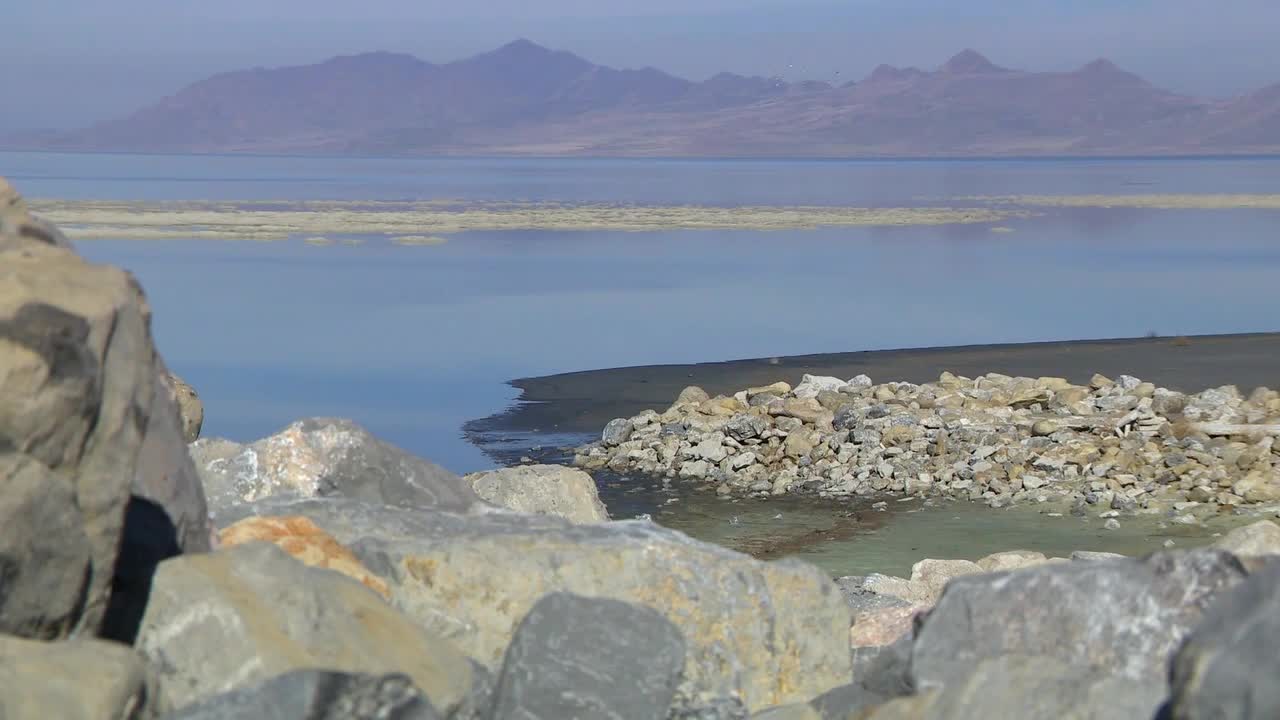


SALT LAKE CITY — New legislation introduced in the Utah State Legislature will set a series of targets for how much water people should be using and how much should be dedicated to the Great Salt Lake.
A resolution sponsored by Sen. Keven Stratton, R-Orem, and a companion bill sponsored by Rep. Thomas Peterson, R-Brigham City, won unanimous approval after a presentation last week before the Legislative Water Development Commission.
"I think what has been produced has been good and addressed a lot of factors that affect water going into the lake," said Rep. Carl Albrecht, R-Richfield.
The legislation directs the governor and legislature to set an initial water allocation target for future municipal and industrial use at 1.4 million acre-feet, calculating for current statewide diversions, future need for population growth and current conservation trends. For agriculture? It's 3.8 million acre-feet, "consistent with current statewide diversions for agricultural use." The Great Salt Lake would get an initial water allocation target of 2.18 million acre-feet, "much of which may be realized through current efforts by the Legislature, executive agencies, and private entities," the resolution states.
"We’re looking at what the level is for the Great Salt Lake, but also the whole macro-ecosystem of our water use. It’s helpful to have an idea of how much water do we have to work with," Sen. Stratton said in an interview with FOX 13 News.
The result of the legislation could impact overall water use across Utah.
"What it does is try to put some goals in place today and then, with the companion bill, to allow that ongoing levers and course correction as needed, as we move forward in the next few decades," Sen. Stratton said.
But the numbers thrown out in the resolution may not be what ultimately passes the upcoming legislative session. Sen. Stratton and Rep. Peterson have already been negotiating with various water stakeholders from environmental group to agriculture interests.
"We're working with both of them to refine those numbers so we're all singing off the same sheet of music," said Great Salt Lake Commissioner Hannah Freeze, who is tasked by Utah political leaders with saving the lake that has dropped to historic lows in recent years triggering a public and ecological crisis.
Dr. Ben Abbott, the founder of Grow the Flow, an environmental group that is among those that has rallied the public and pressured state leaders to do more to save the lake, called the proposed legislation "a fundamental shift in our relationship with water."
"For a long time, we've needed a mechanism to make sure that our water consumption is below the water supply," he told FOX 13 News on Tuesday. "This is a really exciting framework that says, 'Let's assess each year how much water is available, and then make sure that we have a target that's below that.' So, I think this is a really good step forward."
At last week's hearing, Utah Rivers Council Executive Director Zach Frankel, said he would suggest some tweaks, though he appreciated the goals of the resolution. He objected to the resolution claiming $1 billion allocated by the Utah State Legislature on water conservation and infrastructure improvements actually helps the lake if it's not delivered to it.
Questions have been raised about how much water the state of Utah can realistically secure to reverse the lake's declines. Governor Spencer Cox set an ambitious goal last year of raising the lake to 4,198-feet in elevation by the 2034 Winter Olympics. That's considered the low-end of a healthy ecological level, though environmentalists have cautioned that people should not focus so much on a specific number, but a "range" of what's healthy for salinity, wildlife and humans.
Simulations run by a strike team led by Utah State University and the University of Utah found a push to add 250,000 acre-feet of water a year would still leave the lake well below the governor's goal.
Commissioner Freeze said the goal remains in place and work is being done to secure water for the lake through a mixture of public and private purchases and donations.
"We're going to try our best to make that realistic and I think it’s important to remember, we’re just barely getting started. So we look at maybe hey we’ve not gotten a ton of water dedicated to the lake — yet, is what I like to add to the end of that sentence. So we’re working. These tools are now in place and we’re going to now be able to see them pick up more and more in the coming years."
Asked by FOX 13 News if the state has changed its goals or moved the goalposts of what is achievable, Commissioner Freeze replied: "No. Those goalposts are the same."
The Great Salt Lake Commissioner is seeking funding to continue to purchase, lease or secure donations of water for the lake in the Utah State Legislature. Since the lake hit a historic low in 2022, lawmakers have allocated more than $1 billion for water conservation measures statewide.
Dr. Abbott urged people to get involved, pointing out that public pressure can ensure measures to help the lake. Grow the Flow is recruiting people to participate in the upcoming legislative session.
"There are two interesting things that I see in this resolution and proposed bill. One of them is that it acknowledges that we're not getting enough water to Great Salt Lake," he said. "We are the cause of the lake's decline, and this is the first time I've seen in legislation a specific acre-foot target of additional flow recognizing that we need about a million acre-feet more a year to reverse the lake's decline. That's a big step forward."
Read Sen. Stratton's proposed resolution here:
Read Rep. Peterson's bill on water targets:
This article is published through the Great Salt Lake Collaborative, a solutions journalism initiative that partners news, education and media organizations to help inform people about the plight of the Great Salt Lake—and what can be done to make a difference before it is too late. Read all of our stories at greatsaltlakenews.org.