



Bed sores that led to sepsis. A medication error that resulted in a possible accidental overdose. A resident who allegedly choked to death on a breakfast burrito that wasn’t safe for him to eat.
These are the types of problems advocates say have contributed to the premature — and preventable — deaths of vulnerable older adults who rely on Utah’s assisted living facilities and nursing homes for care.
“I’ve certainly seen reports of deaths that didn’t make a lot of sense,” said Nate Crippes, an attorney with the nonprofit Disability Law Center of Utah, in an interview with FOX 13 News. “You look at enough of these and you really see the same problems over and over again.”
Yet he argues many of these fatalities don’t receive the scrutiny they deserve — in part because of what he sees as a presumption that older adults in these settings were bound to die.
Their deaths are often not reviewed by the state’s Fatality Review Committees, which seek to identify systemic changes in state-regulated facilities to prevent future harms. And when regulators find issues within a facility, Crippes believes the financial penalties levied against them are too low to induce reforms.
“I think a lot of our system is yeah, we just say, ‘Oh, you did this wrong, don’t do this again, here’s your plan of correction,’” he said. “And then a week later the same thing happens and we’re going to do the same thing. You know, at the end of the day, that’s not going to solve any problem and it’s not going to make the system work better.”
FOX 13 News identified at least 24 cases in Utah’s assisted living facilities and nursing homes since 2019 that have raised questions of negligence, inadequate staffing, medical errors or poor staff training.
Federal regulators cited the state's nursing homes for their role in six deaths during that time, according to a FOX 13 News review of thousands of pages of federal inspection reports.
Other allegations are raised in ongoing court cases — a path Rachel Sykes, an attorney who has represented clients in cases against long-term care facilities, says many families pursue when they feel other avenues have failed.
"Sadly, sometimes the only way to hold these facilities accountable is through litigation,” she said in an interview. “The family and I think victims that have lost a loved one due to nursing home abuse or neglect would love to see more oversight and love to see more accountability from the agencies that regulate and look at what’s going on in these facilities.”
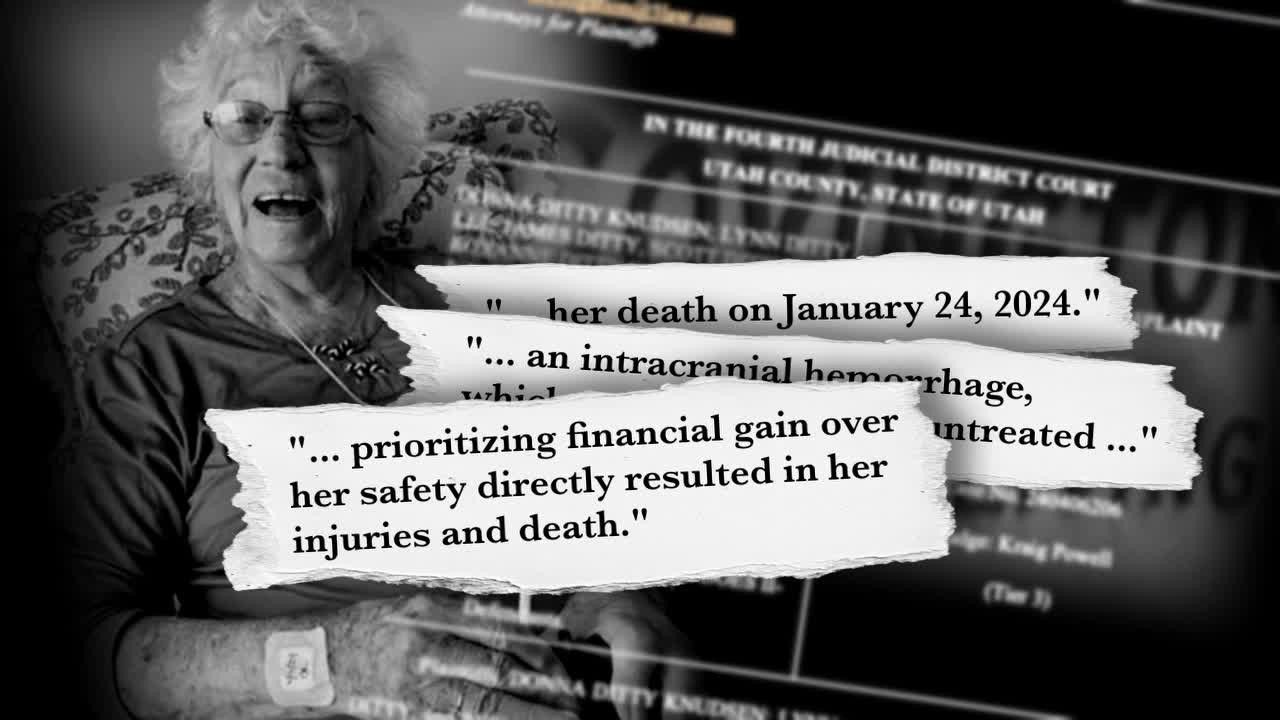
Scott Ditty and his siblings are currently pursuing a lawsuit against the Orem assisted living facility where his mother died after a fall in early 2024. He believes her death could have been prevented and wants to see more attention on fatalities in Utah’s long-term care facilities.
"She was not ready to go,” he said of his mother, Ruth Ditty. “She deserved better. Everyone deserves better. Our seniors are a vulnerable population. But they need to be a more valuable population in our society.”
In response to questions about wrongful death allegations in long-term care facilities, the Utah Health Care Association said in a statement that providers operate “under some of the most rigorous oversight in health care.” That includes “extensive state and federal regulations, routine and complaint-based surveys, mandatory reporting requirements, investigations, enforcement actions, and corrective plans when deficiencies are identified,” continued Allison Spangler, the group’s president and CEO, in an email.
“Allegations raised in lawsuits are not findings of fact,” she added, “and each case must be evaluated within its specific clinical and regulatory context.”
'Serious, avoidable care problems’
When someone dies in a state-owned or operated facility — or if they were receiving services from a division of the Department of Health and Human Services (DHHS) at the time — their death often prompts a deeper investigation by one of the state’s Fatality Review Committees.
The goal of these reviews is to evaluate deaths and identify systemic changes — whether “to procedures, policies, law or training” — that can help improve services and “prevent future client deaths,” according to a spokeswoman with the department.
But when someone dies in a nursing home or assisted living facility, “nobody is really doing that,” Crippes notes.
DHHS does review deaths of older adults in these facilities if the person had an open case with Adult Protective Services at the time of their death or in the year before — but only if their death was deemed a homicide, suicide or undetermined cause.
Fatality reviews aren’t a “perfect system” and may not find “all the problems they should,” Crippes said. But without a broader look at the factors that contributed to deaths in nursing homes and assisted living facilities, he fears preventable issues may continue to occur.
“I think the state really should conduct these reviews system-wide,” he said.
A 2011 ProPublica investigation found suspicious deaths of older adults are rarely thoroughly investigated nationwide, though some communities have formed elder death review teams to look into cases of possible abuse or neglect.
Arkansas, for example, requires a review even of nursing home fatalities attributed to natural causes, according to ProPublica.
In the first four and a half years after the Arkansas law went into effect, the Pulaski County Coroner reported 86 deaths due to "suspected resident neglect" to state regulators, according to a 2004 report by the U.S. Government Accountability Office.
While those made up a small fraction of the overall number of nursing home deaths, the office said the referrals suggested “serious, avoidable care problems,” with more than two-thirds listing pressure sores “as the primary indicator of neglect.”
The office concluded that the “serious, undetected care problems identified by the Pulaski County coroner are likely a national problem not limited to Arkansas.”
In Utah, Crippes said his requests that policymakers require more thorough reviews of deaths in nursing homes and assisted living facilities have sometimes been met with skepticism.
One legislator he spoke with about the idea countered that “a lot of these deaths aren’t going to be suspicious,” Crippes recalled.
“I’m not going to disagree that when you’re talking about an aging population, a lot of people probably are going to pass away in facilities,” Crippes said. “But again, I don’t think it’s too much to ask to then really take a look at what were the circumstances? Why are we just saying, ‘Oh, these are all just fine?’”
A DHHS spokeswoman noted that the Fatality Review Committees follow state law to determine which deaths qualify for a closer look and that any expansion to those definitions would require the Legislature to change that law.
Asked about the idea of expanding these reviews, the Utah Health Care Association said it is “always willing to engage in discussions about improving resident safety.”
But Spangler added that any additional review of facilities “must be clearly defined, avoid duplicating existing oversight and be focused on objective, evidence-based improvement rather than creating new layers of punitive review.”
VIDEO BELOW: Nate Crippes with the Disability Law Center advocates for a more systemic approach to addressing issues in Utah’s long-term care facilities
Separate from the Fatality Review process, Crippes also wants to see higher financial penalties imposed on facilities when federal regulators find problems in facilities.
The Disability Law Center found in 2022 that Utah ranked 39th in the country for financial penalties against nursing homes over the previous three years, with an average survey-based fine of about $14,000 per nursing home at that time.“Ultimately, the cost to them matters,” Crippes said of these facilities. “And so I think if the state is unwilling to impose serious fines on places, that does seem problematic.”
DHHS said in a statement that its approach to financial penalties is guided by federal and state regulations through a publicly available, tiered enforcement process, and that fines are reinvested back into the community through projects that “directly enhance” resident quality of care and life.
But the department noted that if a provider is eligible for both state and federal penalties, the state generally levies the higher of the two fees, “to avoid putting an unsustainable financial burden on providers.”
'Part of the solution’
As he thinks about his mother's life, Scott Ditty says he remembers her as someone who was “dedicated to service.”“Her family was always No. 1,” he said in an interview. “But professionally and even socially she was just devoted to serving other people.”
Ruth Ditty spent her career as a registered nurse, then as an instructor, “training people to provide professional, expert and compassionate service to those that need it,” Scott Ditty said.
As his mother aged and began exhibiting early signs of dementia, Scott Ditty said he and his siblings urged her to move in with one of them so they could help care for her. But she wanted to have her own space. So the family eventually helped her move to Covington Senior Living, an assisted living center in Orem, in 2022.
As Ruth Ditty's health continued to decline, her son said “she started falling. Regularly.”
She took her last fall in early 2024, down a stairwell after attending church services. She broke her shoulder and suffered traumatic head injuries from the fall, according to the complaint.
The lawsuit alleges that Ruth Ditty lay "injured and unattended" for more than six hours before she was found.
"When they found her at the bottom of the stairs, they didn’t call 911,” Scotty Ditty said. “They didn’t bring a doctor in. They just lifted her up and had her walk down the hall, or had her walk up the stairs, put her in a wheelchair and took her to her room and put her in bed. And… essentially decided that was it for her.”
Even though she had a known allergy to it, the lawsuit alleges a hospice agency then put her on morphine.
A few days later — on January 24, 2024 — Ruth Ditty died from what the lawsuit alleges was an untreated brain bleed.
The complaint, which is ongoing, also accuses Covington of "prioritizing financial gain” over her safety by failing to reevaluate her service plan or transfer her to a more secure memory care unit as her health declined.
Instead, the lawsuit says the facility encouraged the family to pay for more expensive ancillary services — including two-hour wellness checks — that added up to about $5,450 a month. Those checks don’t appear to have been performed the day the lawsuit alleges she spent more than six hours in the stairwell.
“I hate to make it all about money,” Scott Ditty said. “But if you’re talking dollars and cents, it would have saved us money for mom to be in a memory care unit and it would have taken better care of her.”
Covington has denied that and other claims of wrongdoing in court documents.
In a statement to FOX 13 News, the facility said, “Ms. Ditty was a beloved member of the Covington Senior Living Community, and our condolences go out to her family.”
“Covington cannot comment further,” the statement continued. “This case is in litigation and needs to proceed through the court process, not the media.”
Jeffrey Eisenberg, an attorney with the Elder Care Injury Group who is representing Ditty’s family in their complaint, is pursuing dozens of other cases against nursing homes and assisted living facilities in various stages.
More than half of those cases “involve mistakes that were so bad that the patient died,” he said in an interview, including allegations of deaths that resulted from malnutrition or sepsis.
"Some of those things end really badly for people, because they’re sick; they’re old,” he said.
By pursuing litigation in these cases, Eisenberg said he hopes the firm can help “shine a light” on what he sees as pervasive problems in long-term care settings.
“It’s part of the solution,” he said. “Because people want these facilities to be safer than they are, and they want them to be better staffed with better trained staff. That’s what it comes down to.”
For Scott Ditty, he believes there were multiple points where his mother should have received better care. And he thinks her death was ultimately preventable with systemic changes — including better staffing, training and oversight.
“She devoted her life to training people to take care of others,” he said of his mother. “And the tragic irony of how incompetence in the medical field contributed to her death is just... it’s just beyond words.”
Read more from the FOX 13 Investigates team's ongoing coverage of Utah’s elder care systems:
- These Utah nursing homes received millions through a program meant to improve care
- State audit: Millions meant to improve Utah nursing homes were never spent on care
- What are your discharge rights from a long-term care facility? It depends.
- Older adults are being discharged out of long-term care facilities — and into homelessness
- 'More psych than we can handle': Utah nursing homes struggle to address residents' mental health needs
- ‘It should never happen’: Vulnerable adults sexually assaulted inside Utah nursing homes
- Why FOX 13 News is reporting in-depth on gaps in Utah’s elder care systems
- Consensual sex between residents, employees in long-term care raises concerns
- Q&A: Utah’s Long-Term Care Ombudsman is ready to advocate for you and your loved ones
- Utah’s Adult Protective Services is substantiating few cases of elder abuse
- What you should know before choosing a nursing home
- Older adults are wandering away from Utah care facilities, sometimes with tragic outcomes
- Critics say taxpayer dollars for nursing homes should be spent on care, not new buildings
- Nursing homes receiving millions in extra taxpayer funds face allegations of poor patient care